


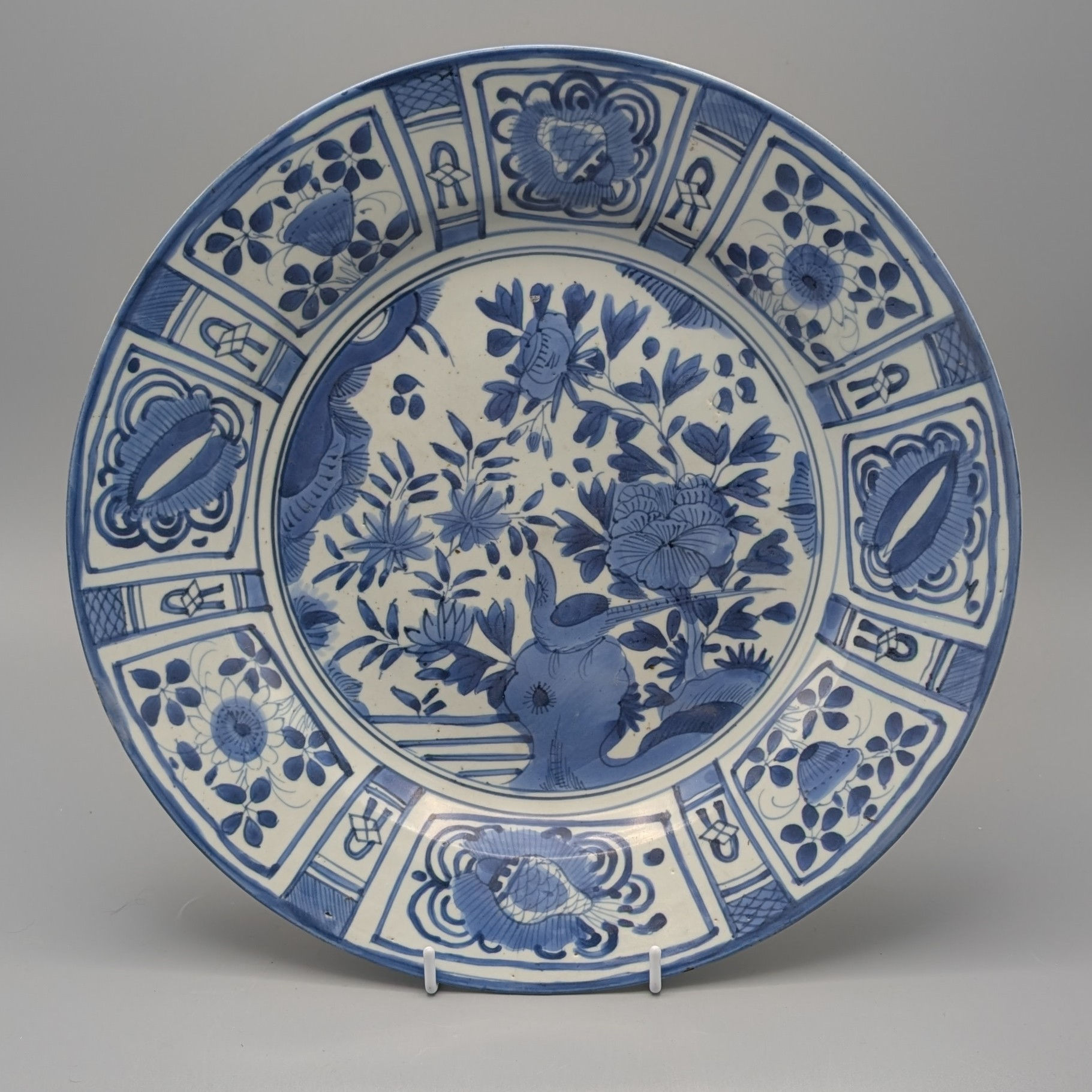

Edo Period Arita Kraak Style Charger
Underglaze blue Japanese Arita charger, c. 1700. Dimensions: Approximately 12 ¾” diameter. Decoration:
The border is decorated with eight alternating decorative panels of flowers and symbols, separated by smaller narrow panels. In the center is a design of long-tailed bird on rockwork with peony and flowering branches. The reverse is undecorated and the base has 5 kiln spurs. With the disruption of the Jingdezhen kilns in the middle of the 17th century, the Dutch East India Company (Vereenigde Oostindische Compagnie or VOC) turned to Japan to provide porcelain for the Dutch market. This was primarily blue and white wares produced at the Arita kilns. Blue and white plates and dishes like this were decorated in the Wanli Kraak style, i.e. a border divided into panels of at least two patterns with a pictorial center design. The Arita versions closely mimic the Chinese Wanli Kraak style, but often with distinctive Japanese elements. By the 1680s, the Jingdezhen kilns were back in operation, producing porcelain for export in larger quantities and at lower cost than the Japanese kilns. Consequently, imports from Japan rapidly declined. However, Dutch East India Company imports and private trade continued into the 18th century. References:
Barry Davis Oriental Art, “Ko-Imari Porcelain from the Collection of Oliver Impey”.
Impey, “Japanese Export Porcelain”.
Jorg, “Fine & Curious, Japanese Export Porcelain in Dutch Collections”.
MacGuire, “Four Centuries of Blue & White”.
Rinaldi, “Kraak Porcelain”.
The Kyushu Ceramic Museum, “Complete Catalog of Shibata Collection”. Condition: In excellent condition consistent with age and usage. Please examine the photos; they are part of the description.